Showing posts with label 2NL. Show all posts

Thursday, 20 December 2007

Trying to play superLAG

I watched a couple other people's videos today where one of them were playing extremely LAGgy in 6 max. I normally play 6 max the way I'd play full ring with the first 3 hands folded. So in the video the guy says, "T8s UTG, I'll raise that... Q8o UTG+1, I'll raise that" and I'm thinking Wai... Wha...? It just blew me away. The preflop play and his incredibly wide range wasn't what was so mind blowing, it was the overall postflop play and the image he was creating even at extremely low stakes. He said you still have an image at the micros, it just takes really exagerated plays to adjust it.

So I tried this out today in 6 max at the 2NL tables on Stars - my experiment level - and finished exactly breakeven over 500 hands running at 40/30, something that is completely foreign to me. I actually played 1/2 of my hands on the button and cut off - weird. I think this is going to work with some practice. What is happening and what I hadn't really thought of before is that by making slightly -EV plays preflop and in small pots, you increase the value of your +EV plays by so much more in large pots, especially against the TAGs and the HUDbots who will either misinterpret your stats or get tired of you raising and playing so many hands. I think this most resembles Daniel Negreanu's style of play, lots of pots and lots of small ball play. When they come back at you you know they have a hand for the most part unless they've figured you out (at which point you can switch gears) and they commit a lot of chips to find out if you have a nut hand or not.

I would have finished up quite a bit in terms of BB if it weren't for this hand and a couple others. It's a bad beat obviously, but it demonstrates just how light you can expect to be called down and this is the situation I want to put myself in every time. This guy had been calling me down with 2nd pair a lot and since he bet 1/5 of his stack, I figured a min raise would pot commit him with anything he's opening with, with a smaller chance of pushing him out. He'd be c/r with a set here I think, so I put him on a draw or 2 overs or a bare 7. Notice how he overplays a hand that beats nothing but a bluff - which he obviously thought I was. Great hand history converter by the way:

Poker Stars, $0.01/$0.02 NL Hold'em Cash Game, 6 Players
LeggoPoker.com - Hand History Converter

MP: $1.32
CO: $1.09
Hero (BTN): $5.78
SB: $1.19
BB: $1.89
UTG: $2.47

Pre-Flop: K 7 dealt to Hero (BTN)
UTG folds, MP calls $0.02, CO folds, Hero raises to $0.08, SB folds, BB calls $0.06, MP calls $0.06

Flop: ($0.25) 2 7 3 (3 Players)
BB checks, MP bets $0.50, Hero raises to $1, BB folds, MP calls $0.50

Turn: ($2.25) Q (2 Players)
MP checks, Hero bets $0.25, MP calls $0.24 and is All-In

River: ($2.73) 6 (2 Players - 1 is All-In)

Results: $2.73 Pot ($0.10 Rake)
MP showed 6 7 (two pair, Sevens and Sixes) and WON $2.63 (+$1.31 NET)
Hero mucked K 7 and LOST (-$1.32 NET)

Tuesday, 27 November 2007

Venturing into 6 max

I decided to keep up the high variance play that I've been experiencing today, albeit I am back at Stars, by trying out some 2NL 6 max and ran pretty well! I was 12 tabling for the most part and made about 15 2NL buyins which is the equivalent of what I lost earlier at 10NL full ring on FTP, so I'm happy. People sure stack off a lot lighter than even at 2NL full ring. I felt like I was playing so many hands since this was deepstacked again - stuff like 64s, 96s that I would normally fold preflop. Despite that I was still only running 23/10/1.5 according to Poker Tracker.

Played 1800 hands and ran at an awesome 40BB/100. I might try this 6 max thing out for the next couple of days, that winrate is double what I ran at for 2NL full ring, so hopefully I can keep close to sustaining it. If I run good tomorrow for the first 1000 hands I'll go to 5NL and play deepstacked there. The only thing I don't like is having to open up so many tables because tables break up so fast. Should probably get a script to do that for me.

Tuesday, 13 November 2007

10k hands of 5NL completed

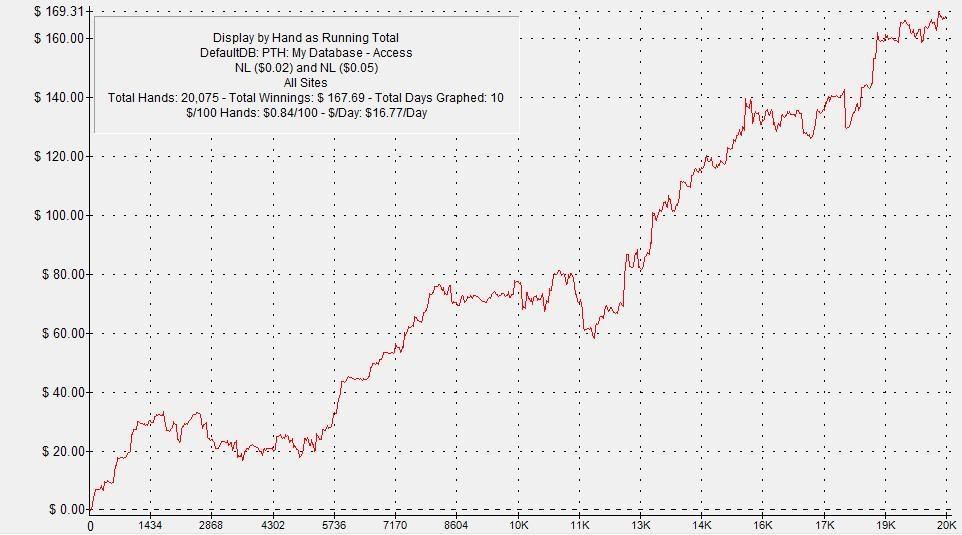
I squeezed in 10k hands of 5NL playing deepstacked since the weekend. It went pretty well I think, my hourly winnings were a little bit higher than at 2NL. My BB/100 dropped to about 1/2 as much which is to be expected, but the blinds were 2.5 times bigger so that made up for more than the difference:


You can see where I made the switch at 10k hands, and at 11k I was trying to adjust a little bit, so that accounts for a bit of a downsing. So here's some tips for making the move from 2NL to 5NL.

MOVING FROM 2NL TO 5NL

1. There isn't a lot of difference between these levels. Just make sure your bankroll is big enough for it. If you're not comfortable playing deepstacked, there's nothing wrong with buying in for 100BB or $5. I suggest playing 100BB buyin if you have ~$100 and deepstacked if you have ~$200.

2. One of the major differences that I noticed is that there are not nearly as many people limping into the pot as at 2NL. At 2NL it is not uncommon to get 6 or 7 limpers. At 5NL you'll be looking at 3-4 limpers most of the time and not quite as many people calling preflop raises.

3. 3 bets at this level are still pretty much JJ+ and the occasional AK. If you have a fairly tight image at the table, try a squeeze play where you reraise in LP or in the blinds to steal with hands like 89s or 66 which can still flop a monster. This also will get you a free turn card almost always as your opponents will check to you and if you want to try to take it away on the flop, your fold equity increases drastically. When your opponents call a 3 bet they are pretty much in fit or fold mode - watch out for check-calls though, these are often overpairs.

4. My aggression factor decreased a bit as I had a better feeling for what my opponents held and I was allowing them to make a lot of bluffs on whiffed draws. For example, I hold AKo, raise preflop, and the flop is Kh7h2s and I bet out of position and villain calls. Turn is Tc and I bet again, villain calls again. River is 5s. All of the draws have missed and 2pair is unlikely, so now I go into check call mode. The reason for this is that if I bet, I am only going to fold out hands that I beat and hands that beat me are going to either call or raise such as a set. If I allow my opponent the chance to bluff a missed flush draw, I get the maximum value out of the hand. I only call villain's bet, I do not raise, for the same reason that I do not lead out in the first place. This is how to get maximum value out of an opponent that you think is drawing.

Thursday, 8 November 2007

Finished 10k hands of 2NL

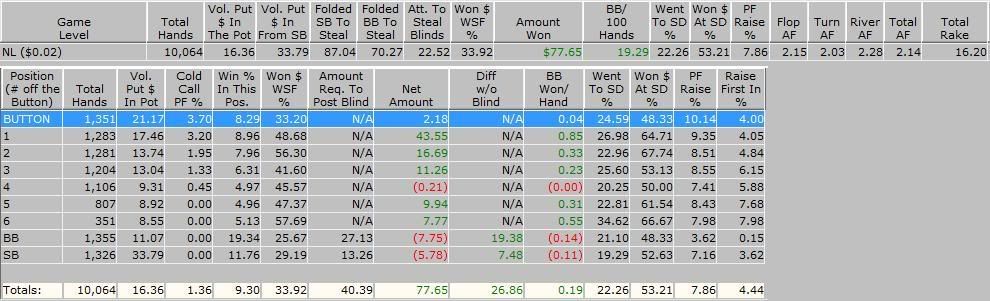
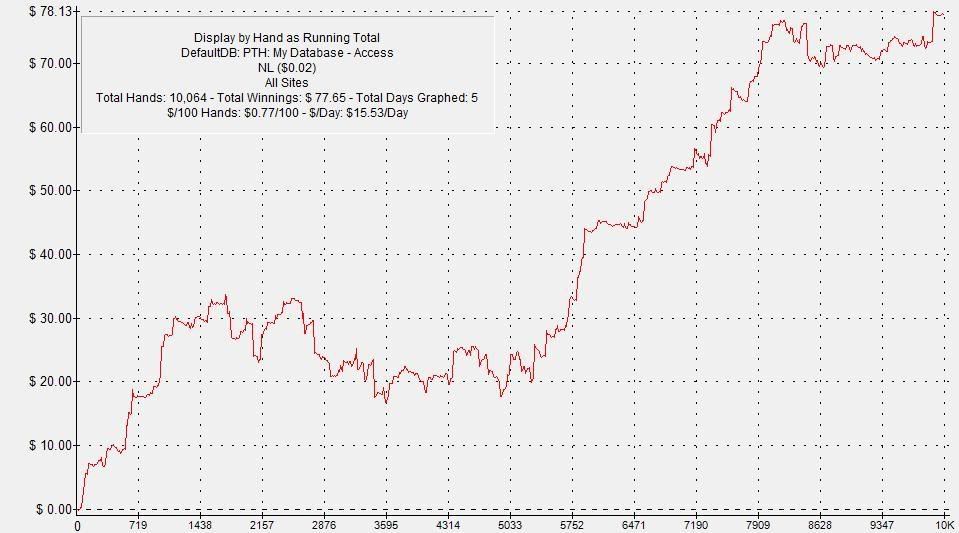
This will be another tl/dr. They'll be shorter in the future. I finished the last 3000 hands of 2NL today to bring me up to a total of 10k. Ran according to the average for the past couple of days: 20BB/100. Here's my stats over the whole period which started last weekend and a graph.


I ran pretty good to start with and also had a really good stretch yesterday when I was hitting set after set (hit a set around 18% of the time when I had a pocket pair, which is quite a bit over average). The areas where it plateaus, I pretty much just ran card dead and didn't get paid off at all when my draws hit or when I hit a set.

If you look at the stats, you'll see that I ran at about 16/8/2, which is a little more nitty than I would have like to have played, but it worked out allright.

So some final tips for playing 2NL before I move one to the next level:

MORE 2NL TIPS

1. Deepstacks. I found that being deepstacked was a huge advantage to me, so I looked for tables that had a lot of full stacks. People buying in for $2 is good enough as well, but your options open up so much more when there's a few deepstacked players and your drawing hands increase in value due to bigger implied odds. Try a couple tables deepstacked when you're comfortable. Don't be afraid to raise those suited connectors and small pocket pairs!

2. Aggression is good. Now I said in my other post not to bluff at these levels. I will add that in a lot of situations it is major +EV to semi-bluff when you're on a draw to help build a pot for when you hit your hand. A lot of people say that players at this level don't think a whole lot about what they are seeing you do, but the one thing that I think they do notice is when you appear to be bluffing a lot. I only had an aggression factor of 2, meaning I was betting and raising twice as much as I was calling. This helps to build a LAGgy image even though I'm still playing my TAG game, and people will be calling down your bets a lot lighter to try to catch you bluffing.

3. Value bet. When you hit your hand, do not slow play it, especially if it is hidden. You can win quite a bit at this level when you hit a monster by playing it fast. What is your natural instinct when you hit a huge hand? Slowplay, right? And that's exactly what everyone expects you to do, so do the opposite. Hit trips on the flop and you're in the SB? Anyone who had trips wouldn't open the betting would they? BET IT. Hit a set on an A high board and your opponent raised UTG? RERAISE. River a fullhouse with 4 to a flush on the board? Do not check-raise. GO ALL IN. Your opponent will be thinking that you must be bluffing again and will decide to play sheriff often enough for this to be hugely profitable, especially being deepstacked. If they fold, you weren't getting their money anyways.

4. Common Patterns. There are a few common things that micro stakes players will do when they have a monster. If you can recognize these, you can get away very cheaply and save yourself a ton of money. While patterns mean different things to different people here are some general ones that can be applied to probably more than 50% of the players at this limit.

*A player who limp/calls preflop, check/calls the flop, then check/raises the turn has genuine strength almost always. This is a set so many times its not even funny.

Lets say you have JJ, and raise on the button with 3 limpers, 2 of them call. Flop is 942r. Player 1 and 2 both check, and you make a standard continuation bet. Player 2 calls. Player 2 checks again, you make another 3/4 pot size bet on the turn J.

This is where you need to take notes on how players play their sets: a lot of them will min-raise you, some of them will raise a pot sized bet, and a few will go all in. But once you have them figured out, it's quite easy to put them on 99 44 or 22 and they let you get away for as cheap as possible.

Going back to value betting and aggression, if I raise preflop and bet out on this flop, are you ever going to put me on 44? Probably not. You'll probably put me on A9 T9 and TT-QQ which you are ahead of and I'll stack your JJ a lot more often because almost no one plays a set that way.

*Taking a long time to bet when there are 3 flush cards on the board. Most of the time they will have the flush, they are just trying to figure out how much they can get you to call. Take notice that this does not apply to multi-tablers who may be acting on another table. If you find a multi-tabler, put it in his notes right away so that you don't misread a delay.

*A quick call. This is often a draw and they are thinking ahead of time that they are going to call x amount. When you bet that amount or less it's almost as good as if they had the call button pressed ahead of time. Once in a while you'll find someone who either uses this to scare you (they'll do this a lot if that's their intention) and some people do it when they have a monster and are impatient to see the next card. Again, take notes.

So I'm off to 5NL tomorrow. I'll play 10k hands of that as well, all deepstacked at 200BB ($10). I will try my best to keep up the winrate, although I do suspect it will drop slightly due to stacks being not quite as deep and a little less limping and less than half the table calling preflop raises. I probably won't be adding quite as many tables so it'll take a little longer to get in the 10k.

Wednesday, 7 November 2007

Nearly 10k hands of 2NL - Still going strong

I've just about completed my 10,000 hands of 2NL. I found that I was just crushing the games, so I decided to ramp up on tables. I'll be refering to ptBB/100 hands as BB/100 from now on to simplify a little bit (for those that don't know, a ptBB is 2 times the big blind. It was originally developed for limit and it counted in terms of Big Bets). So any time I refer to something like 10BB/100 at 2NL, I am saying (10 x 2) x $0.02 = $0.40/100 hands.

So I dropped to 18BB/100 for November due to a bunch of coolers yesterday costing me quite a few buyins. I think I actually ran at -1BB/100. Set over set, KK vs AA, that sort of thing - nothing I can do about that. Today was much better and I ran at 40BB/100 for 1700 hands to bring my winrate up again over 7100 total hands. I'll post a graph and some stats once I hit the 10k hand mark - most likely tomorrow.

I said before that I normally 6 table full ring, but since I've found these game so incredibly easy, I've actually been running between 12 and 16 tables. When I 6 table, I just tile the tables and they fit nicely on my widescreen with no overlapping, although the tables are as small as I can make them.

Now with 16 tables I obviously can't do this because everything would be a mess. What I've found works for so many more tables is to make them the size of half the width of your monitor and stack them all on the left side in one pile. Make sure that you set your options to make the active table pop to the top when you need to act and you're all set. If there is a hand that I am particularly interested in I pull that table off to the right side so that I can watch the action more closely, write down my notes, and move it back. I've also noticed that this helps a lot in terms of making decisions as each hand that pops up is just one decision. I was trying to watch all 6 tables at once when I tiled them and couldn't keep track of any of them. Having them stacked basically gives you "yes or no" decisions, and then you move on.

I thought I'd share some multi-tabling tips that I've picked up for those that are new to the idea:

MULTI-TABLING TIPS

1. If you feel bored, multi-tabling may be for you. It helps you to let go of marginal hands because better hands and better situations will be coming along much quicker.

2. Start off by adding 1 table at a time until you feel comfortable to add another. If you find yourself panicking when you here the incesant beeping of the timer going off or even timing out, drop a table.

3. Keep an eye on your winrate. If you can pull in 6BB/100, you may drop to 5BB/100 if you add an extra table because your concentration will be divided. This may sound counterproductive, but it will actually increase your hourly winrate. Before, if you could get in 100 hands per hour you would be earning $0.24 per hour at 6BB/100, but at 5BB/100 on 2 tables you earn $0.20 per hour per table for a total of $0.40 per hour. I suggest finding a happy medium and make sure that your earnings per hour are optimal.

The point of multi-tabling is to help you get to the long term faster.

Monday, 5 November 2007

Starting off small - 2NL

I decided that I would make this a bit more interesting by starting off at the lowest stakes possible - namely 2NL at Stars. The lowest I've played before this was 10NL. 2NL - and 5NL as well for that matter - are a bit of an anomaly at Stars as they allow you to buy in for more than 100BB; the standard for any other limit. Instead, they allow you to buyin for 250BB at both of these levels. This is exactly what I intend to do at both of these levels as most players do not understand how to play deepstacked and I am assuming that my implied odds are going to skyrocket.

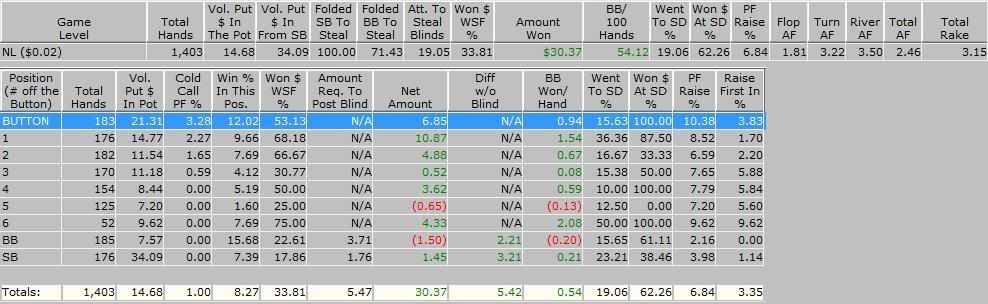
I didn't get to play quite as much as I would have liked to this weekend, but I managed to get in 1400 hands, so here are the results:


I don't know if 50 ptBB/100 is really sustainable but at least I'm off to a good start!

So here's some thoughts on how to beat 2NL and what has been working for me so far:

TIPS FOR 2NL

1. DO NOT BLUFF. These players are calling me down with any piece of the board, coordinated or not. Also trust them when they are betting or raising, they don't bluff as much as you think they would. If they check the flop and then bet the turn, the turn helped them.

2. Value bet. When I hit 2 pair or better I start betting 3/4 to full pot sized bets or even if I have top pair and a good kicker and I think my opponent is calling me down with a worse kicker or better yet, second pair. Hitting a set is a real moneymaker at this level. I don't slow play these at all, especially on an A or K high board, you can stack a lot of people with a set because they will not lay down top pair.

3. Tighten up, especially from early position. I usually play a lot looser than the 14/7/2.5 that I played over these 1400 hands, but when you have 5 people calling a 5BB raise preflop, you need to be coming in here with a hand that can flop very well or can stand on its own. A lot of people would say that you need to raise more to get less callers, but I feel that even with these players, raising more isn't necessarily +EV because you can not make a standard continuation bet and push them off their hand when you miss like you can at higher levels. That being said, I still like to raise a lot when I have position against a lot of the players at this level because I will get a lot of value out of them when I do hit. You have to remember that pots grow exponentially. An unraised pot is not going to get nearly as big as a raised one.

For those of you that are new to the no limit game, consider this:
If you have 2 players (lets say the button and the BB) that are going to see the flop one will bet the pot all the way to the river and the other will call...
a) an unraised pot will be - 2.5BB on the flop, 7.5BB on the turn, and 22.5BB by showdown
b) a pot with a preflop raise to 3BB will be - 6.5BB on the flop, 19.5BB on the turn, and 58.5BB by showdown
c) a pot with a preflop raise to 4BB will be - 8.5BB on the flop, 25.5BB on the turn, and 76.5BB by showdown

So for hands where you want to build a large pot, slowplaying does not help your cause much. You need to build that pot early on in order to get more value later in the hand. This applies to all levels of play, not just the micros.

Anyways, I plan to consider moving up to 5NL once I have played 10,000 hands of 2NL. 10,000 is still a small sample size, but it will give me an idea of my winrate at that level and a winrate to try to match for the next level. Bankroll management is not really an issue at this level as I said I will be starting with $200.